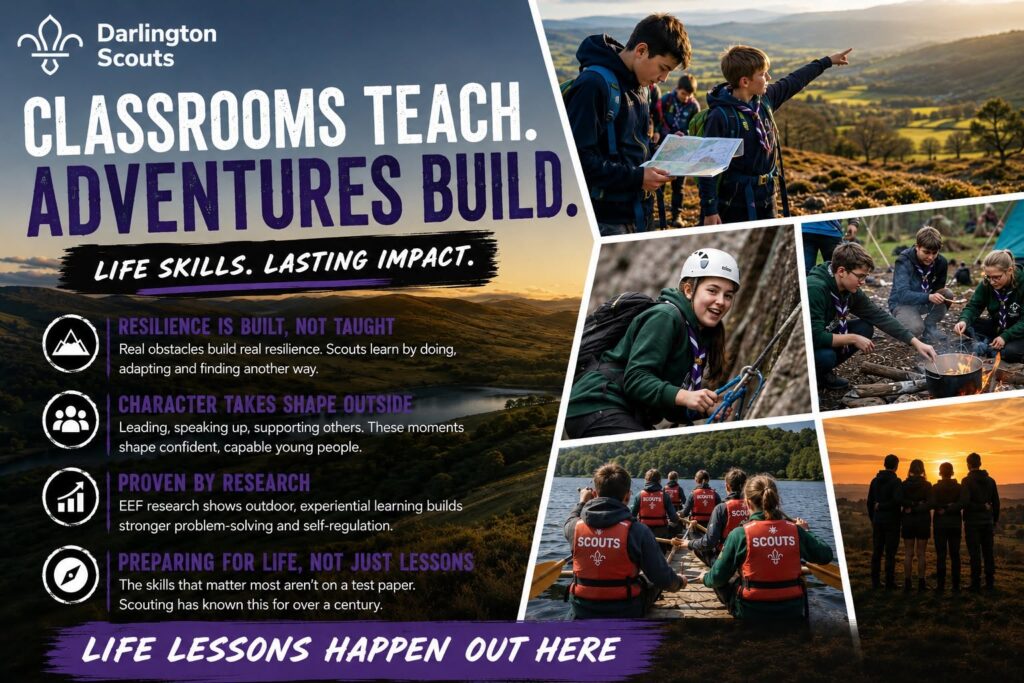
Ask most adults where children learn resilience and they will point to a classroom. We would point somewhere else entirely.
Resilience needs friction. A young person builds it by navigating a real obstacle, not by reading about one. When a Scout plans a route that fails and has to find another way, that experience becomes a mental model they carry for life. No worksheet replicates it.
Character works the same way. Confidence grows from doing things that feel uncertain: stepping forward to lead a group, speaking up during a challenge, supporting a teammate who is struggling. Repeated across years, those moments shape how a young person approaches work, relationships, and responsibility. The outdoors is simply where they happen most naturally.
Recent work from the Education Endowment Foundation points the same way, with young people in outdoor, experiential learning showing measurably stronger problem-solving and self-regulation than peers in purely classroom-based settings.
The skills that matter most in adult life are rarely the ones tested in a classroom. Scouting has known this for over a century.